
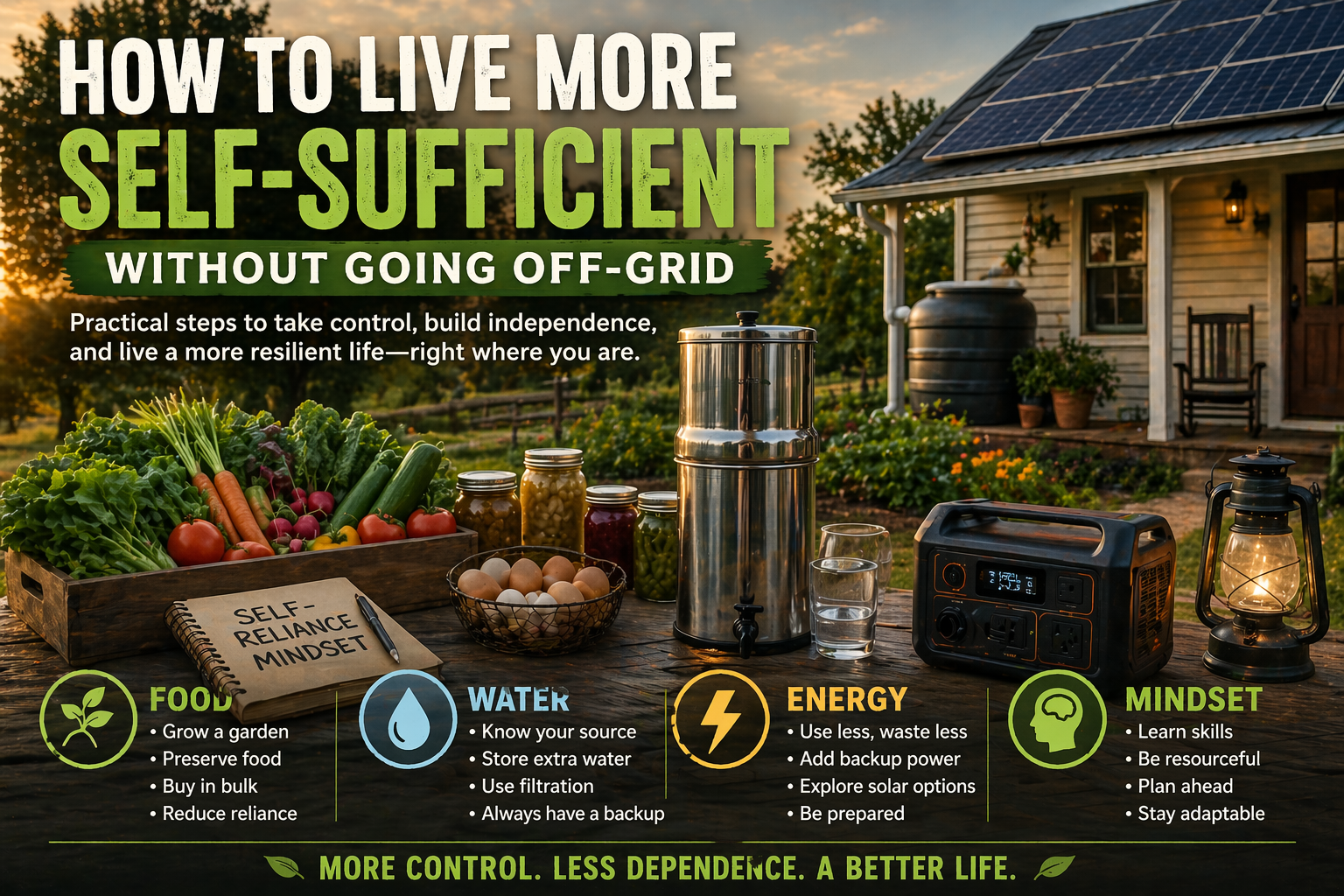
Key Takeaways
- Learn the systems already on your property before adding new projects.
- Prioritize water, sanitation, shelter, food, and basic repair capability.
- Build redundancy for outages and short-term disruptions without trying to go completely off-grid.
- Improve one system at a time and keep records so each season makes the property easier to manage.
Self-Reliance Is a System, Not a Costume
There is a difference between living in the country and knowing how to live in the country. You can own acreage, park a pickup beside the barn, keep chickens behind the house, and still depend on somebody else every time a pipe leaks, the power goes out, the driveway washes, or the well pump quits.
Real self-reliance is less dramatic. It is knowing where the shutoffs are, understanding the systems that make the property work, maintaining tools before they fail, growing at least some useful food, and having a reasonable backup plan for predictable interruptions.
A rural property is a collection of systems: house, water, wastewater, power, roads, drainage, fencing, heating, food storage, tools, animals, gardens, and outbuildings. Every one of those systems eventually needs attention. The people who thrive in the country learn to understand them rather than simply use them.
Start With Water
Water should be near the top of every country homeowner's priority list. If you have a private well, know where the wellhead, pressure tank, controls, filters, and shutoffs are located. Keep any available drilling and repair records. Learn what depends on electricity and what happens when power is lost.
The Centers for Disease Control and Prevention says private well owners are responsible for their own water quality and recommends testing at least once a year for total coliform bacteria, nitrates, total dissolved solids, and pH, plus any locally important contaminants identified by health authorities.
Stored drinking water adds a simple layer of resilience. The goal does not have to be supporting a household indefinitely. Enough clean water to carry the household through a short outage can keep a routine failure from becoming an urgent problem.
Understand the Septic System
Many rural homes use onsite wastewater systems. Know where the tank and drainfield are. Keep heavy vehicles, buildings, and unnecessary excavation away from the drainfield, and do not treat the toilet like a trash chute.
The U.S. Environmental Protection Agency recommends routine septic inspection and pumping based on system type, tank size, household size, water use, and solids accumulation. A commonly cited interval is inspection about every three years for an average household system and pumping roughly every three to five years, although actual needs vary.
Maintenance is much cheaper than discovering the system only after sewage backs up into the house.
Produce Some of Your Own Food
You do not need forty acres and a tractor to become more food independent. A manageable garden that reliably produces vegetables your household actually eats is more useful than a huge neglected garden planted because somebody else's homestead checklist said you should.
Start with familiar crops. Add fruit, berries, herbs, or a few laying hens if they fit the property and your schedule. Build one food-producing system until it works before adding three more.
Food production becomes far more valuable when it connects to storage. Plan for freezing, drying, safe canning, or suitable cool storage before the harvest covers the kitchen counter.
Learn Ordinary Repairs
Country living becomes expensive when every small failure requires a service call. You do not need to become a licensed electrician, master plumber, mechanic, carpenter, and welder. You should be able to diagnose simple problems and handle basic maintenance safely.
Learn to shut off water, locate electrical breakers, repair gates, patch fencing, maintain batteries, change filters, sharpen simple tools, grease equipment, tighten loose hardware, and recognize when a problem is beyond your ability.
Knowing when to call a professional is also self-reliance. High-risk electrical work, gas systems, dangerous tree removal, structural failures, and specialized well work can become much more expensive when a homeowner turns a manageable problem into a dangerous one.
Build a Tool Collection Around Real Jobs
The best rural tool collection is not the biggest one. It is the one that solves the problems you actually encounter. Dependable hand tools, digging tools, cutting tools, basic mechanic's tools, fencing tools, lighting, measuring tools, and appropriate protective equipment cover a surprising amount of country work.
Buy specialized tools as jobs justify them. A tool you use repeatedly is an investment. A tool bought because an online list said every homesteader needs it may become expensive wall decoration.
Learn the Land Before You Fight It
Country property changes with the seasons. The dry pasture in August may hold water in March. A quiet creek can become a flood route. A sunny winter garden site can be shaded once trees leaf out.
Watch where water moves, where frost settles, which soils stay wet, how the wind crosses the property, where wildlife travels, and which trees threaten buildings or utility lines. USDA Natural Resources Conservation Service soil surveys can help identify mapped soil characteristics and potential limitations, but observation on the actual property matters too.
Working with the land is usually cheaper than repeatedly forcing the land to behave like a suburban lot.
Prepare for Ordinary Interruptions
A rural power outage may also mean no well pump, limited heat, no refrigeration, disabled electric fencing, and reduced communications. Make a list of everything that stops working when electricity stops.
Keep flashlights accessible, maintain charging options, store reasonable drinking water, keep shelf-stable food, and have a plan for animals. If a portable generator is part of the plan, operate it outside and well away from windows and doors, following the manufacturer's instructions and carbon-monoxide safety guidance.
Make the Property Economically Sustainable
Self-reliance has an economic side. Rural property consumes money through taxes, fuel, fencing, equipment, feed, seed, insurance, buildings, maintenance, and repairs.
Some households offset those costs with produce, eggs, seedlings, repair services, equipment work, firewood where lawful, craft production, online work, workshops, or other appropriate enterprises. The goal does not have to be creating a full-time farm. Sometimes the smartest objective is simply having the property help pay for its own improvements.
Build Capability One Season at a Time
The fastest way to burn out is trying to transform a property in one year. The first year should teach you the land. Repair what is broken. Learn the water system. Understand drainage. Improve essential tools. Start a manageable garden. Establish basic emergency supplies. Keep notes.
Then expand. You plant, something fails, you learn, you repair, and you try again. Eventually the unfamiliar property becomes territory you understand. That accumulated knowledge is the heart of country self-reliance.
Frequently Asked Questions
What does self-reliant country living mean?
It means having the knowledge, supplies, tools, and backup systems to handle common rural problems without depending on immediate outside help for every disruption.
Do I have to live off-grid to be self-reliant?
No. A household can use grid power, stores, contractors, and modern services while still becoming more capable through backup water, food storage, repair skills, and practical planning.
What should a new country homeowner learn first?
Start with water, wastewater, power shutoffs, drainage, access roads, heating, basic repairs, and emergency plans. Those systems affect daily life more than optional homestead projects.
How long does it take to become self-reliant?
There is no finish line. Capability grows through seasons of maintaining the property, solving problems, keeping records, and adding skills deliberately.
Sources and Further Reading
CountryRedneck uses primary government, university, and Extension sources for technical or safety-sensitive guidance. Local rules and property conditions can differ, so verify requirements where you live.
- CDC: Guidelines for Testing Well Water
- EPA: How to Care for Your Septic System
- USDA NRCS: Web Soil Survey
- Ready.gov