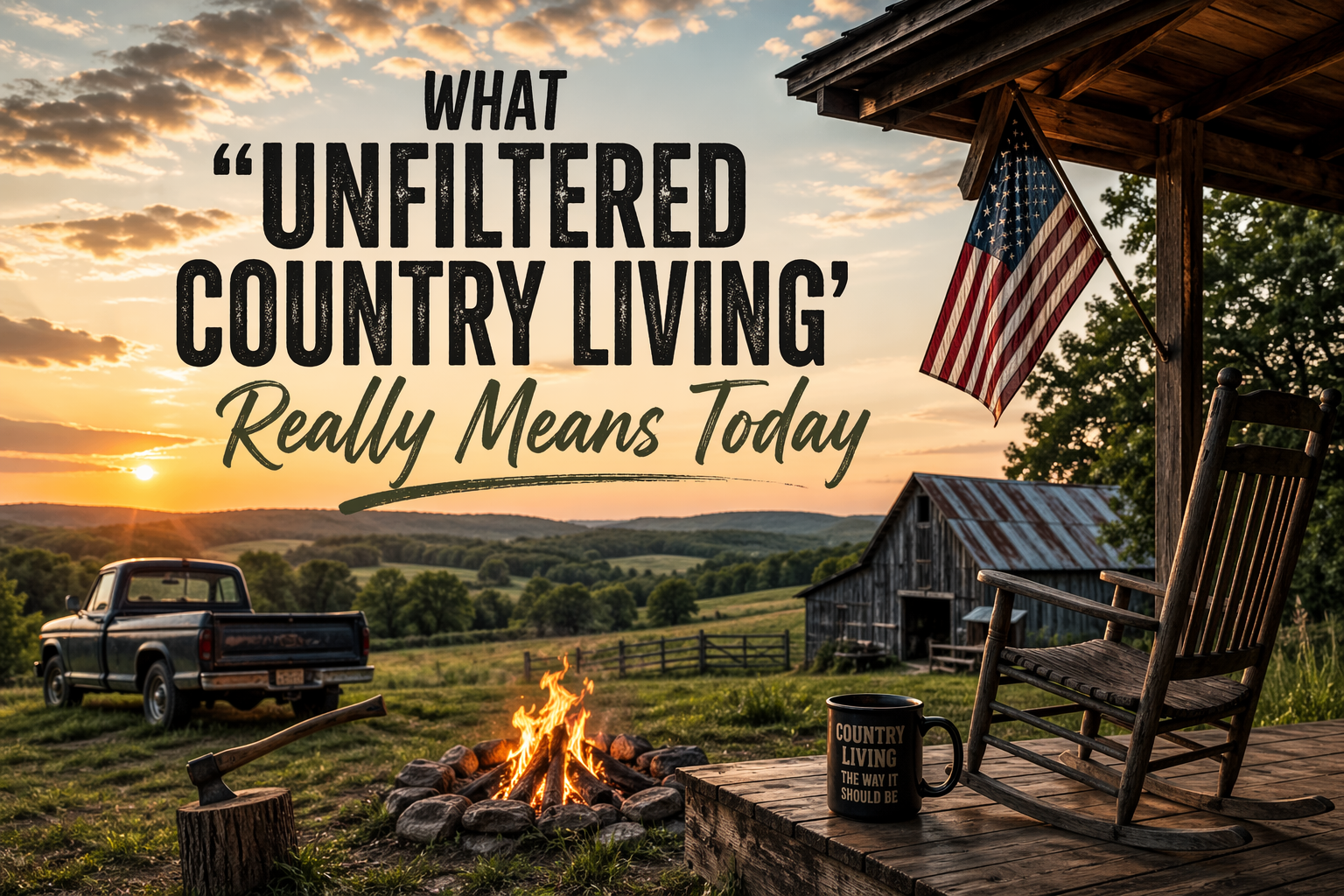
What “Unfiltered Country Living” Really Means Today
There’s a difference between living in the country and living a country life.
One is the location. The other is a mindset.
“Unfiltered country living” isn’t about aesthetics, social media, or recreating some romantic version of rural life. It’s not about staged photos of barns at sunset or curated homesteads that look untouched by hardship. It’s something quieter, steadier, and a lot more real than that.
At its core, it’s about how you choose to live what you rely on, what you value, and how you handle what life puts in front of you.
It Starts with Freedom, But Not the Kind People Think
When people hear “freedom,” they often think of escape. Getting away from something. Leaving behind stress, noise, or structure.
But in the country, freedom doesn’t mean less responsibility.
It usually means more.
Freedom here is the ability to make your own decisions and live with the results of them. If something breaks, you fix it. If something needs doing, you don’t wait around for someone else to handle it. There’s no system quietly carrying the load for you in the background.
That kind of freedom is earned, not given.
It’s the freedom to rely on your own judgment. To set your own pace. To decide what matters and what doesn’t without constant outside pressure shaping those choices.
It’s not loud. It’s not advertised. But once you experience it, it’s hard to trade for anything else.
Self-Reliance Isn’t a Trend, It’s a Way of Life
Self-reliance has become a popular idea lately. You hear it in conversations about homesteading, off-grid living, and “getting back to basics.”
But for people who have lived it, it’s not a trend.
It’s simply how things are done.
Self-reliance doesn’t mean doing everything alone. It means knowing you can handle what comes your way or at least figure it out. It’s confidence that comes from experience, not theory.
It looks like:
- learning how to fix what you own instead of replacing it
- understanding where your food comes from
- being prepared for things not to go as planned
- adapting when conditions change
It also means accepting that not everything will be convenient.
There will be days when things take longer, cost more effort, or don’t go the way you expected. But over time, that tradeoff builds something you don’t get from convenience, confidence.
Not the kind that comes from comfort, but the kind that comes from capability.
The Gap Between Rural Life and Modern Living
Modern life is built around efficiency, speed, and ease. Most systems are designed to remove friction. If something goes wrong, there’s usually a service, an app, or a process that steps in to handle it.
In rural life, that layer often doesn’t exist.
Distance changes things. Time changes things. Access changes things.
A simple task can take half a day. A small problem can become a big one if it’s ignored. Planning ahead isn’t optional it’s necessary.
That doesn’t make one way better than the other. It just means they operate on different rules.
Modern living prioritizes convenience. Rural living prioritizes resilience.
In one, you expect things to work.
In the other, you prepare for when they don’t.
And over time, that difference shapes how you think.
Slower Doesn’t Mean Less
There’s a common misconception that country life is “slower,” as if that means less productive, less driven, or less meaningful.
In reality, it’s just paced differently.
Work is still work. Days are still full. Responsibilities don’t disappear. But the rhythm isn’t dictated by constant noise or external urgency.
You move with what needs to be done not what demands your attention every second.
That shift changes how you experience time.
You notice things more. You finish what you start. You’re not constantly pulled in ten different directions by things that don’t actually matter.
And while that may not look efficient from the outside, it often leads to something more valuable focus.
Values Over Noise
Unfiltered country living strips away a lot of what doesn’t matter.
Not all at once, but over time.
When you’re responsible for your own space, your own work, and your own outcomes, priorities become clearer. You don’t have the luxury of getting lost in things that don’t contribute to your life in a meaningful way.
That doesn’t mean life becomes simple.
It means it becomes more honest.
You start to value:
- things that last
- people you can count on
- skills that actually serve you
- time that isn’t wasted
And you begin to let go of:
- unnecessary complexity
- constant comparison
- surface-level distractions
That shift doesn’t come from a philosophy. It comes from experience.
It’s Not About Perfection
One of the biggest misunderstandings about country living is that it’s supposed to look a certain way.
Clean. Organized. Picture-ready.
But real life doesn’t work like that.
Things break. Weather changes plans. Equipment fails. Projects take longer than expected. Some days feel productive. Others don’t.
Unfiltered means you don’t edit that out.
You accept it as part of the process.
There’s a kind of honesty in that an understanding that progress doesn’t always look polished, and that’s fine.
Because the goal isn’t to create an image.
It’s to build a life that works.
Community Still Matters, Just Differently
Self-reliance doesn’t eliminate the need for others.
If anything, it makes the value of community clearer.
In rural settings, help isn’t always immediate. That means when people show up, it matters more. Relationships are built on trust, not convenience.
You know who you can call. You know who will show up. And you know that when they do, it’s not because it’s easy it’s because it matters.
That kind of connection isn’t always visible, but it’s there.
And it’s strong.
What “Unfiltered” Really Means
“Unfiltered” doesn’t mean raw for the sake of being raw. It doesn’t mean rejecting everything modern or refusing progress.
It means removing what’s unnecessary so you can see what’s real.
It means:
- accepting responsibility
- valuing effort
- prioritizing what actually matters
- living with the results of your choices
It’s not about proving anything to anyone else.
It’s about building something that holds up day after day, season after season.
The Reality Most People Don’t See
From the outside, country living can look like an escape.
From the inside, it’s a commitment.
A commitment to:
- doing things that aren’t always easy
- solving problems as they come
- learning through experience
- staying grounded in what matters
It’s not always comfortable. It’s not always convenient.
But it’s real.
And for a lot of people, that’s exactly the point.
Where It Leaves You
In the end, unfiltered country living isn’t about where you live.
It’s about how you live.
You don’t need acres of land to adopt the mindset. You don’t need to go off-grid or leave everything behind. What matters is the shift in how you approach life.
Taking ownership.
Building capability.
Letting go of what doesn’t matter.
And choosing, every day, to live a little more intentionally than the day before.
That’s what it really means.
Not perfect.
Not polished.
Just real.