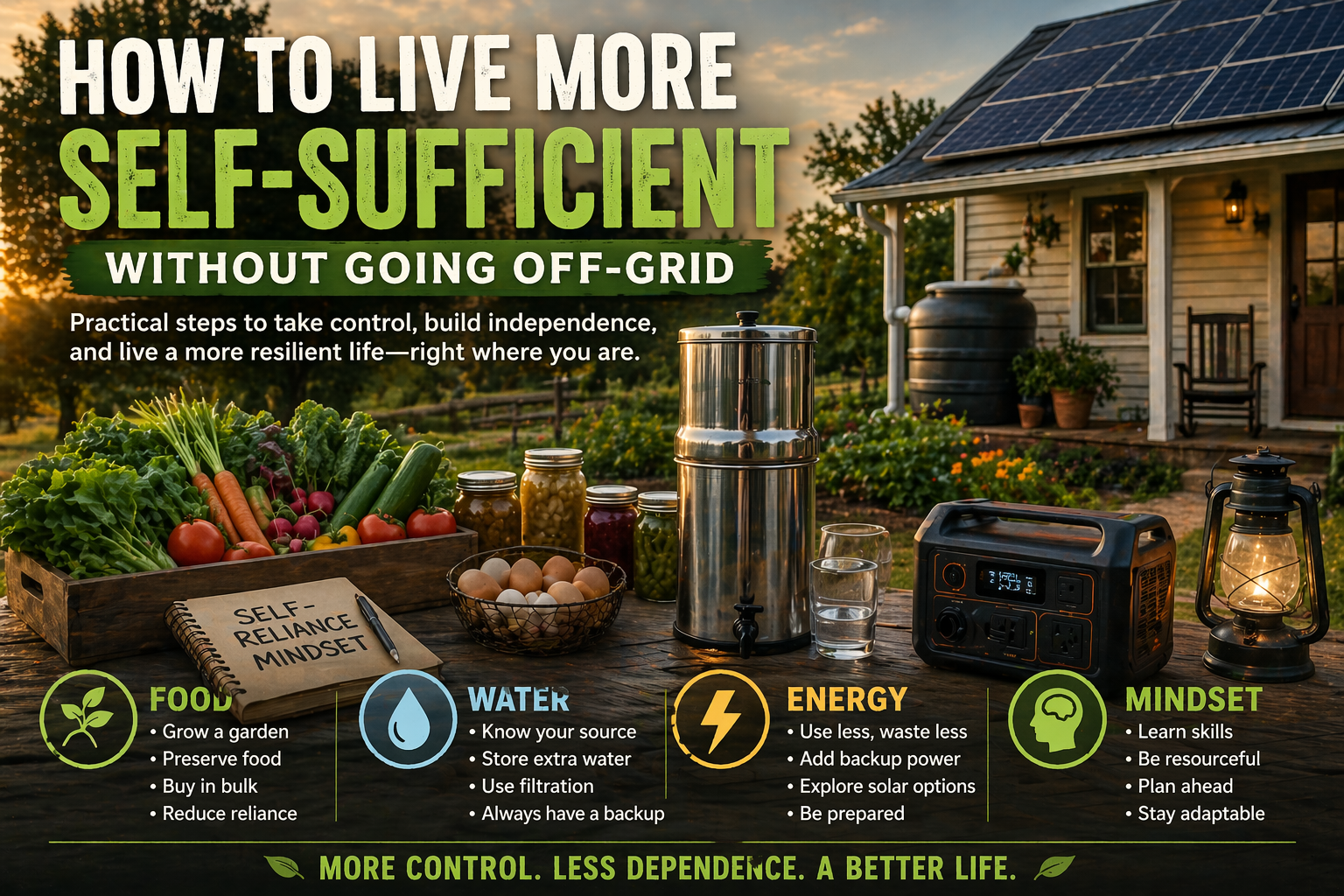
How to Live More Self-Sufficient Without Going Off-Grid
There’s a growing number of people who want more control over their lives.
Not in a dramatic, all-or-nothing way but in a practical, everyday sense.
They’re not looking to disappear into the woods or cut themselves off from the world. They still want electricity, internet, and access to modern life.
But they also want:
- more independence
- fewer vulnerabilities
- and a better understanding of how to take care of themselves
That’s where self-sufficiency without going off-grid comes in.
It’s not about abandoning modern life.
It’s about becoming less dependent on it.
It Starts With a Different Mindset
Before tools, before systems, before anything else, self-sufficiency begins with how you think.
Most people are used to:
- convenience
- immediate solutions
- relying on systems they don’t see
Self-sufficiency flips that.
It asks:
- What would I do if this stopped working?
- Can I handle this myself?
- Do I understand how this actually works?
You don’t need to have all the answers.
But you do need to start asking the questions.
Because once you do, everything else begins to shift.
Food: Start Small, Not Extreme
One of the first areas people look at is food.
And that’s where many go wrong.
They try to do too much too fast like plant gardens, livestock, full independence and burn out quickly.
A better approach:
👉 start where you are
That might mean:
- growing a few basic vegetables
- learning to preserve food
- buying in bulk instead of weekly
Even something as simple as:
- keeping extra pantry staples
- understanding shelf life
- reducing dependency on constant grocery runs
…moves you forward.
Over time, you can expand.
But the goal isn’t total independence.
It’s increased control.
Water: Know Your Source, Have a Backup
Water is one of the most overlooked parts of self-sufficiency.
Most people assume it will always be there.
Until it isn’t.
Whether you’re on city water or a well, you should know:
- where your water comes from
- how reliable it is
- what happens if it stops
At a minimum, you should have:
- stored water
- a simple backup filtration method
This doesn’t need to be complicated.
It just needs to exist.
Because water isn’t something you want to figure out in the moment.
Energy: Reduce Dependence Without Disconnecting
You don’t have to go off-grid to become more energy independent.
But you do need to think differently about how you use power.
Start with awareness:
- what uses the most electricity
- what you actually need vs what’s just habit
Then build from there.
That might include:
- a backup generator
- alternative heating options
- small solar setups for essentials
The goal isn’t to replace the grid.
It’s to stop being completely dependent on it.
Even partial independence changes everything.
Skills Matter More Than Systems
One of the biggest mistakes people make is focusing too much on gear.
They buy:
- equipment
- systems
- tools
But don’t develop the skills to use them effectively.
Self-sufficiency isn’t about what you own.
It’s about what you can do.
Basic skills go further than most people realize:
- fixing simple problems
- maintaining equipment
- cooking from scratch
- adapting when things change
These are the things that actually make you more independent.
Your Home Should Work For You
A self-sufficient home doesn’t need to be complicated.
It just needs to be functional.
Ask yourself:
- Can I stay here comfortably if things stop working for a few days?
- Do I have what I need without relying on immediate outside help?
Small upgrades make a big difference:
- better storage
- backup supplies
- simple redundancies
You don’t need a full system overhaul.
You need a home that can handle disruption without falling apart.
Build in Layers, Not All at Once
One of the biggest reasons people fail at becoming more self-sufficient is trying to do everything at once.
They jump from:
- zero → full overhaul
That rarely works.
Instead:
👉 build in layers
Start with:
- food basics
- water awareness
- small backups
Then expand:
- energy
- tools
- skills
Each layer builds on the last.
And over time, you end up with something solid.
What Self-Sufficiency Is NOT
It’s not:
- isolation
- perfection
- doing everything yourself
And it’s definitely not:
- rejecting modern life
You can still:
- shop at stores
- use the internet
- rely on systems
Self-sufficiency simply means:
you’re not completely dependent on them
The Real Goal
At the end of the day, this isn’t about preparing for some extreme scenario.
It’s about everyday life.
Things break. Systems fail. Situations change.
When that happens, most people feel stuck.
Self-sufficiency gives you options.
It gives you:
- confidence
- flexibility
- control
And that changes how you move through life.
Final Thought
You don’t need land, livestock, or a full homestead to start living more self-sufficiently.
You just need to start thinking differently.
Make small changes. Build gradually. Learn as you go.
Because the goal isn’t to disconnect from the world.
It’s to stand on your own two feet inside it.